

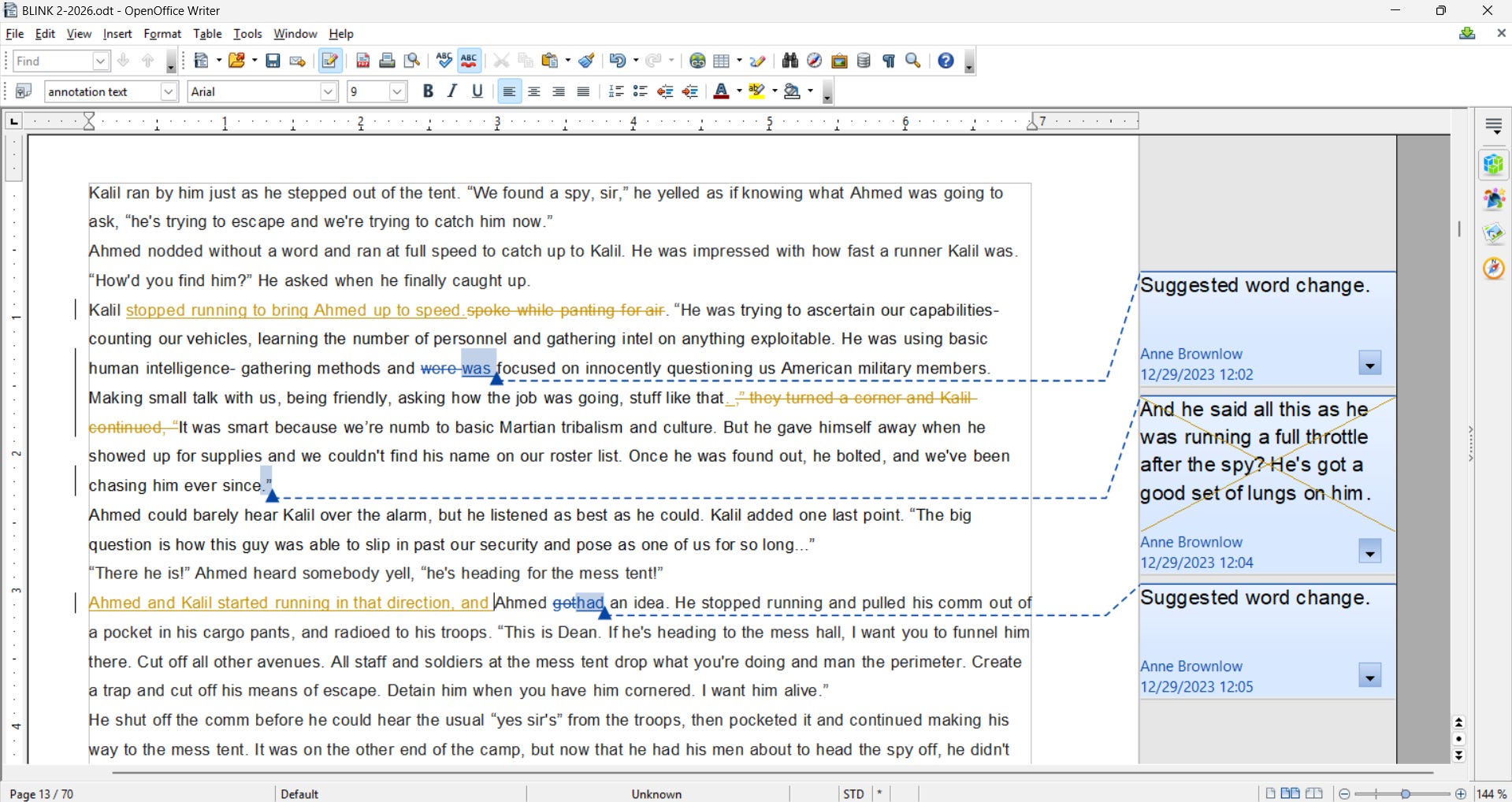
If there is one thing that could possibly be more intimidating to a writer than a blank page, it’s staring at a finished manuscript that looks almost unreadable due to all of the markups and strikethroughs, next to a looong laundry list of suggested edits and revisions from your beta readers and content editor. If you’re like me, you would rather do almost anything creatively than dive back into a story you subconsciously had moved on from. Don’t get me wrong, I welcome constructive criticism. I’ve said as much in previous articles. But receiving constructive critique, edits and revisions is one thing; actually doing anything with them is something else entirely. After receiving my latest round of critiques from a professional beta reader I hired for the last draft of my military sci-fi story Blink, it took me literally over a year to look over the notes and start the next draft of the book. And in that time, I wrote a complete first draft for an entirely new novel, along with making significant progress on two other writing projects, developing ideas for at least two new books and a comic book series, not to mention countless posts for this very Substack.
The mental block for doing major revisions is real. It’s not that you think your first draft is perfect (and shame on you if you do), it’s that when you go into revision mode and start focusing on rewriting your book, storytelling stops being an exercise in creative expression, and starts being work. And the majority of us writers do not want writing to be work - even those of us that do it for a living. It’s like having to renovate a house you’ve already moved out of (which ironically I’m doing right now because we want to rent out our old house). You feel like there is nothing new to discover or explore, because you’ve said everything you really wanted to say about that story in the first draft. Meanwhile, you are getting inundated with new ideas and concepts that won’t leave you alone, and new stories are percolating within you, begging to be told. Here are some ways you can motivate yourself to finally dive into making those revisions instead of just starting something new.
Trust the process
Think of your story as a sculpture. Your first draft of the story was taking that block of marble or ice or wood and hammering away all of the big chunks you don’t need to get it into some rough semblance of what you want your finished sculpture to be. You’ve made a lot of progress, but it’s still only a preview of what your finished product could be. Your first draft is you exploring the possibilities of your story idea and figuring out what your book could be. Now that you know what your story is and how it progresses, you are now empowered to make the story truly work for your audience. This is where your story becomes tighter, more focused, and gains a better flow. In other words, the second draft is when your story actually gets good. You might even discover new aspects and elements of your story in the revision process that you might not have noticed before, because your revisions force you to ask questions about your characters, plot, theme and setting that you might not have thought of when you were writing your first draft.
Eating elephants
Remember the old joke about how to eat an elephant? If not, you eat it one bite at a time. The revision process can appear overwhelming if you look at the totality of changes you need to make. So don’t look at all of them. Concentrate on fixing one aspect of the story at a time, taking multiple passes through the story with your eye on one specific element you are looking to improve. Your first pass could be reexamining your characters’ motivations and how they are presented in the story. Then you go back through and pay attention to the story’s pacing. Once you’re satisfied with that. Go back through a third time with strengthening the story’s dialogue in mind. And after that, you go again focusing solely on making sure your story’s themes are conveyed clearly. And you can finish with a final spelling and grammar check to make sure your new changes are consistent. These bite-sized updates can make the process more manageable, and seeing even a few of those boxes checked off can motivate you to keep going. When revising Blink, the beta reader pointed out times where my protagonist (Space Force General / Point Guard Ahmed Dean) had inconsistencies in how his leadership style was presented. So I focused and entire pass on addressing just that, and that was one less thing I needed to concern myself with moving forward. This process shows your progress in a visible way, which preserves momentum.
Your new idea is a reward, not an escape
While you’re staring down that list of revisions to your current story, I know there are new ideas percolating in your mind begging to be explored. I implore you to resist the temptation to abandon your current story in favor of diving into something new. You can take notes on your new ideas as they come to you, but try not to go too deep into working on your new story ideas because that can and will take you away from refining the story you have that is closer to being publishable. If you keep up that pattern, you will have a pile of first drafts, none of which would be ready for publication. I get it; exploring something new is much sexier than poring over the same story over and over again. I’m guilty of that, too. So here’s how you can use that as motivation. How about dabbling in your new story idea after you’ve made a few revisions to your current story, as a reward? This way you can scratch both itches at the same time. Take some time to check a few of those boxes and hammer out even a few of those revisions, and after that, treat yourself to working on your new ideas.
Rediscover your own Motivation
Here’s a question I want to ask you about your first draft: why did you write it? What was it about that particular story idea that compelled you to explore and develop it to the point that you completed an entire story? What was it about that story that had you excited enough to see it through from start to finish? Was it a question you wanted to answer? A character you wanted to develop? A plot idea you wanted to see resolved, or a world you wanted to explore? That element is still there in your finished story, but now you are a better storyteller, with better tools resources to truly nail what you were trying to get to when younger you first started writing the story. The new version of the story you wrote will land more closely to how you first envisioned it in your mind’s eye, and has the potential to even surpass that. That alone could be reason enough to delve back in and make the changes.
Conclusion
The key to making the revision process seem less like work is how you approach the process. fine-tuning a story is actually a privilege that most never get to experience because most people that talk about wanting to write a book never finish one. You are already in elite company. You’re not staring at blank pages anymore. You have something to work with and build on. And you’re closer to having a publishable version of your story than you think. You don’t HAVE to rewrite your story; you GET to rewrite your story and make it the best version of itself that it can be. Keep that in mind and get started!
Is this article helpful? The Subscribe! I post writing advice articles weekly, along with monthly author interviews and story ideas.
Also, I have merch! Show the world how proud you are to be a writer with one of the items from my shop.

.