

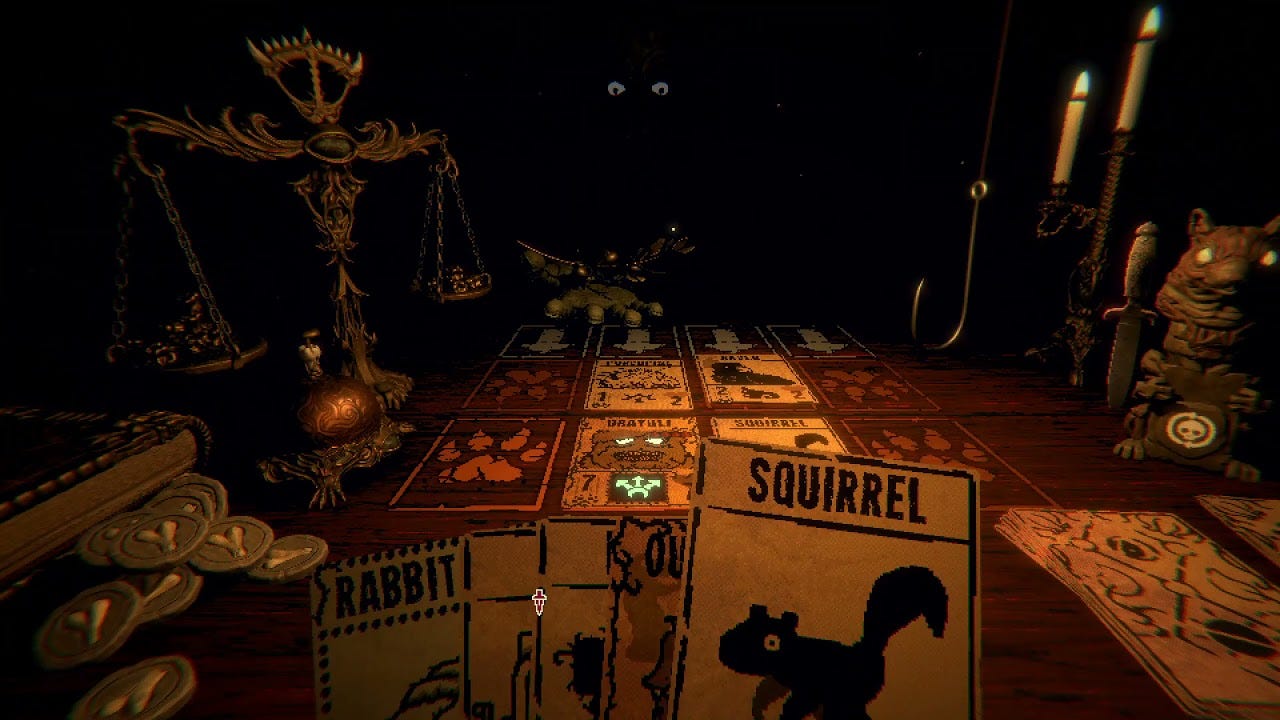
One of the things that makes the hit indie video games Inscryption and The Hex endearing is the puzzle-based scavenger hunts they initiated outside of their respective games, that led to additional content and context within the games. Exercises like this are called ARGs (or Alternate Reality Games), and they are a fun, engaging way your audience can interact with the story and deepen their connection to it. Adding an ARG can add new levels of context and engagement to your story, and can also be used as an effective marketing tool. If you were thinking about adding an ARG to your story, it can seem intimidating. I have compiled a step-by step beginner’s guide to help you put your ARG together in a way that enhances your original story.
A Simple ARG in 8 Steps
Step 1. Define the Core Mystery
Every story has gaps in plot, setting and character that can be explored. Instead of making one of these gaps a subplot or trying to develop it into a spinoff, you can make it the subject of your ARG. Maybe an important character disappears or has a long absence. Maybe your villain’s plot has more intricacies and details than can be covered in your core story. Maybe a backstory event that is referenced is begging to be fully explored. Either way, your plot leaves unanswered questions that can be the mystery that drives the ARG. This is what you will build it around. It’s the truth behind something your main story only partially explains. There are three ways your story can progress: a prequel ARG that explores events before the story (missing case, character origin, hidden lore incident), a parallel ARG that happens alongside the story (Different POV, background investigation, side character journey), or a follow up ARG that happens after your story ends (consequences, unresolved threads, hidden plot twists). Any of these can work, you just need to choose which approach best enhanced your core story
Step 2. Pick Your Story Goal
The Hex’s ARG payoff was worth the journey of getting to it because it revealed a truth about one of the characters at the center of the main story that recontextualized the motivations and actions of other characters in the game. The ARG is essentially a scavenger hunt for information, and the gathered information should lead to a payoff or revelation that enhances the core story the ARG is part of. So in this instance you would work backward and start your ARG planning at the end. After you’ve defined the mystery the drives your game, immediately ask yourself what the solution to the mystery is. Is it a hidden scene that didn’t make it into your story? Could it be a secret, revealing monologue from one of your characters? Maybe your players get to see the ending of your story from a different perspective, or find a plot twist that changes how they view the story. For instance, after sifting through scattered clues and solving complex puzzles, the Inscryption ARG leads you to an unlisted Youtube video that essentially undermines everything one of the other characters was trying to accomplish in the game. It’s a real gutpunch that changes how you view the entire experience. When planning your ARG, think of the end first, and build backwards from that.
Step 3. Pick Characters For Your Story
Not all ARGs focus on characters, but many of them do. Inscryption featured Kaycee, an arbitrary character in the game that had a heavy focus in the ARG. having a character involved puts a face on everything that is going on and gives your audience someone to invest in. You want to involve characters that maybe fall through the cracks in viewer attention, like minor characters, or characters referenced that don’t actually have an active role in the story. Maybe you want to focus on a deceased character, or a victim, or a henchman. You can use an investigator, or a journalist researching for a news story. Characters that don’t get a lot of attention in your main story would make for ideal characters to build your ARG around. And you want to employ unconventional methods to present these characters with. utilize them communicating with email, short videos, social media accounts, or simple text logs. Your ARG could mirror or parallel a journey that these characters embarked on.
Step 4. Decide Where the Game Lives
This is where the challenge of creating an ARG truly begins. You need to pick the platforms your audience will use to interact with the ARG and experience the story you are trying to tell. Ideally, these platforms will feel like a part of the world of your story, to enhance immersion. Start with a few, manageable media to engage your audience with. if you want to post a fake website for an organization in your story, consider using Google Sites or wordpress.com. You can post any found footage or character vlogs with unlisted videos on Youtube. You can create fake gmail accounts to show your characters sending and receiving emails. You can craft puzzles using things like puzzlescript or simple Google Docs. You can create QR codes and have them link to anything you’ve created, then place those QR codes strategically. Many digital ARGs like for Inscryption, Frog Fractions 2 and Tunic involve finding ciphers inside the game’s source code, or hiding clues in other video games, or revealing clues in real-world artifacts and events (one clue in the Inscryption ARG famously gave away coordinates to a place where a floppy disk was buried that contained yet another clue). Tunic had a puzzle with a solution that led to a website that had an audio file with a hidden message you can find if you open the audio in a spectrogram and interpret the images within that are written in the game’s proprietary language. If you know how to create cipher-based puzzles (here is a great resource for that - https://playcryptograms.com/cryptogram-maker), That is an effective way to create engagement.
Keep a database or list of the different elements of your ARG (including the payoff), and where they are located so you know what parts you have to work with.
Step 5. Create the First Entry Point
The next thing you want to figure out is at what point do you want your audience to start engaging with the ARG. there should be something either within the story or tangential to it that sparks an interest in delving deeper. One of the earliest examples of this is the ad campaign for the puzzle game Riven, which had ads that were wordless environment pictures, with the Riven website URL scrawled onto the scenery. Both Inscryption and The Hex had bizarre codes and instructions that hinted at something deeper. Both Westworld and Mr. Robot had in-universe websites that could be accessed both in the TV shows and in the real world. You should plant a clue either directly in your story or within your marketing materials that leads to your ARG. It could be something like a leaked file, or a social media post from a character, a strange message on your story’s official website, QR code in the background of one of your ads, or a random website casually mentioned in the text if your story. You want your audience asking themselves if that weird detail is something they can actually look up.
Step 6. Build a Chain of Clues
Now you want all of your clues to link together. Not only that, but each clue should also reveal some hidden lore of your story that builds until you give the audience access to your payoff moment. At this point you want to take time to sequence your clues and set them up so that finding one clue leads to the puzzle that unlocks the next clue, which is also a revelation that adds deeper context to what us going on within your main story…and leads to the next clue. For instance, that random link you placed in the background in your political thriller leads to a job post for a campaign manager on LinkedIn, but visiting the website of the company posting the job opening has a password protected employee login where the reader could find the password mentioned by the corrupt politician in the core story, and logging in unlocks an employee chat log where they discuss the grand conspiracy of your story and talks about one of the accomplices that got murdered early on your core story, with a jpeg of their obituary that has a code hidden in its metadata that leads to an unlisted YouTube video of that person pleading for help before “they” get to them. Keep your puzzles relatively easy so you don’t deter anyone from making the discoveries. And each puzzle solution and clue should feel like unlocking a hidden part of the story.
Step 7. Establish Rules for Player Interaction
There are numerous elements to fine-tune to make sure your game runs smoothly. Here are some questions you need to ask: Will the game be live? (You respond in real-time as characters.) Or pre-scripted? (Everything is already built, players can’t break it.) Will players need to work together? Will you answer out-of-game questions if something breaks? In addition to that, you want all your communication with the ARG players to have the same feel as your story. Your horror ARG necessitates limited responses and eerie delays, while your thriller ARG wants real-time messages and urgency.
Step 8. Playtest With 1–3 Friends
Like with any game, it’s best to playtest it before launch. Progress through the ARG with a few of your buds and take notes about what is working and what isn’t. Do the puzzles make sense? Does the narrative feel coherent? Did they get stuck anywhere? Do they even care? The best stories leave an impact, and your ARG should, too. Once you’ve compiled your notes, tweak your game and test again with a new group of testers. Once you are confident your game is running smoothly, then you can launch it, preferably by subtly directing consumers of your story to where they can find that entry point.
Conclusion
Putting together an ARG requires some forethought and planning, but the reward is a new way to engage your audience and get them involved in your story in a way they will remember long after they have finished your core narrative. If you feel you are up to the challenge, I recommend giving this a try.
Is this article helpful? Then subscribe! I post writing advice articles weekly.
And BTW, I have merch! Show the world how proud you are of being a writer by rocking an I SELL WORDS t-shirt or coffee mug. (I got other stuff too). Visit the link below to get yours

.